

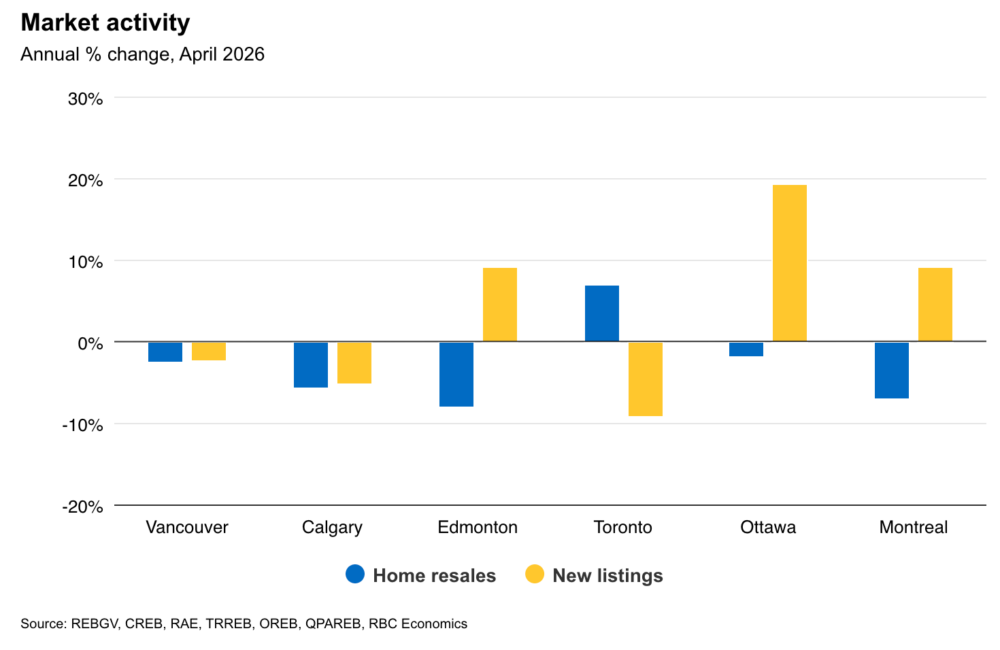
Canada’s spring housing market is unfolding with a familiar seasonal increase in listings — but without the strong surge in buyer demand many had anticipated. Early April data from local real estate boards across the country paints a mixed picture, with some regions seeing modest gains in activity while others continue to cool.
What’s becoming increasingly clear, however, is that sellers are returning to the market in greater numbers, reshaping supply-and-demand dynamics in several major cities.
A Patchwork Market Across Canada
Housing activity in April varied significantly depending on the region.
Several major markets recorded increases in home resales compared to March, including Toronto, Ottawa, Calgary, Edmonton, and the Fraser Valley. Despite these month-over-month improvements, sales activity in many of these cities still remains below levels recorded a year ago.
Meanwhile, other markets such as Vancouver, Montreal, Regina, and Saskatoon experienced additional modest declines in transactions, reflecting ongoing buyer hesitation and uneven economic confidence.
This divergence highlights a national market that continues to lack a unified direction. Instead of a broad-based recovery, Canada’s housing sector remains highly rationalized, with local affordability, employment conditions, and inventory levels shaping outcomes city by city.
Listings Surge as Sellers Re-Enter the Market
One of the strongest emerging trends this spring is the rise in new listings.
Most regions reporting April data saw a noticeable increase in properties coming onto the market compared to March. In some cities, including Montreal and Ottawa, inventory levels have climbed to record highs for this time of year.
This growing supply is shifting negotiating power in several key markets.
In Toronto and Vancouver — Canada’s least affordable housing markets — buyers continue to hold the advantage due to elevated inventory levels and softer demand. As a result, price corrections are continuing in both regions, giving buyers more leverage during negotiations and reducing the urgency often associated with previous spring markets.
Elsewhere, conditions remain more balanced. In many Prairie provinces, Quebec communities, and Atlantic Canadian markets, supply and demand are more evenly matched, allowing home prices to continue appreciating at a steady pace.
Why Buyers Are Still Hesitating
Traditionally, spring is the busiest season for Canadian real estate. Yet this year’s market has not delivered the strong momentum many industry observers expected.
Buyer confidence remains fragile as Canadians navigate several layers of uncertainty, including:
- Concerns surrounding global trade tensions and economic instability
- Ongoing geopolitical conflicts
- A softer labour market in some sectors
- Persistently high housing costs and affordability challenges
- Elevated borrowing costs compared to recent years
These factors are causing many potential buyers to delay major purchasing decisions, even as inventory improves and negotiating opportunities emerge.
What This Means for Buyers and Sellers
For buyers, current market conditions may present opportunities that were difficult to find during the highly competitive years of the pandemic housing boom. Increased inventory in major urban centres is creating more choice, less bidding pressure, and greater negotiating flexibility.
For sellers, success increasingly depends on realistic pricing, strong presentation, and understanding local market conditions. While demand remains resilient in certain regions, buyers are more cautious and price-sensitive than they were in previous spring markets.
Outlook: Uncertainty Continues to Shape the Market
Canada’s housing market appears likely to remain uneven in the months ahead.
Until broader economic uncertainty begins to ease — whether through improved affordability, stronger consumer confidence, or greater economic stability — housing activity will probably continue to vary significantly between regions.
What is evident so far this spring is that supply is growing faster than demand in many parts of the country. Whether buyers regain confidence later in the year could determine how Canada’s housing market performs through the remainder of 2026.
For now, the spring market remains active — but cautious.